









EU Battery QR Code under Regulation 2023/1542: Who Is Responsible — The Supplier or the Importer?
Nov 12, 2026
Leave a message
A practical guide to battery QR codes, required information, website setup and labelling rules from February 2027.
The EU Battery Regulation (EU) 2023/1542 introduces new requirements for battery information and labelling. One important change is the QR code requirement, which will apply to all batteries from 18 February 2027.
But what information should be behind the QR code? Who should create the website? Can the importer generate the QR code? And what if the battery is too small to carry one?
If you are a battery manufacturer, supplier, importer or a buyer of battery-powered products, this guide will help you understand the main requirements and prepare for them.
When Will the EU Battery QR Code Become Mandatory?
According to Article 13(6) of Regulation (EU) 2023/1542:
"From 18 February 2027, all batteries shall be marked with a QR code."
This means that the requirement covers all five battery categories:
- Portable batteries
- Light Means of Transport (LMT) batteries
- Electric vehicle (EV) batteries
- Industrial batteries
- Starting, Lighting and Ignition (SLI) batteries
However, there is an important difference.
Not every battery needs a full Digital Battery Passport.
|
Battery category |
QR code destination |
|
EV batteries |
Digital Battery Passport |
|
LMT batteries |
Digital Battery Passport |
|
Industrial batteries over 2 kWh |
Digital Battery Passport |
|
Other batteries |
Applicable battery information and required documents |
|
SLI batteries |
Applicable information, plus recovered material information |
For EV, LMT and industrial batteries over 2 kWh, the Battery Passport must contain more detailed information about the battery model and, where required, the individual battery.
For other batteries, the QR code must provide access to the applicable battery information, the EU Declaration of Conformity and waste battery information.
For SLI batteries, additional information about recovered cobalt, lead, lithium and nickel is required.
In short: All batteries need a QR code, but the information behind the code depends on the battery category.
What Information Should Be Available Through the QR Code?
For batteries that do not require a full Battery Passport, Article 13(6)(b) requires access to the applicable information under Article 13(1)–(5), along with other required documents.
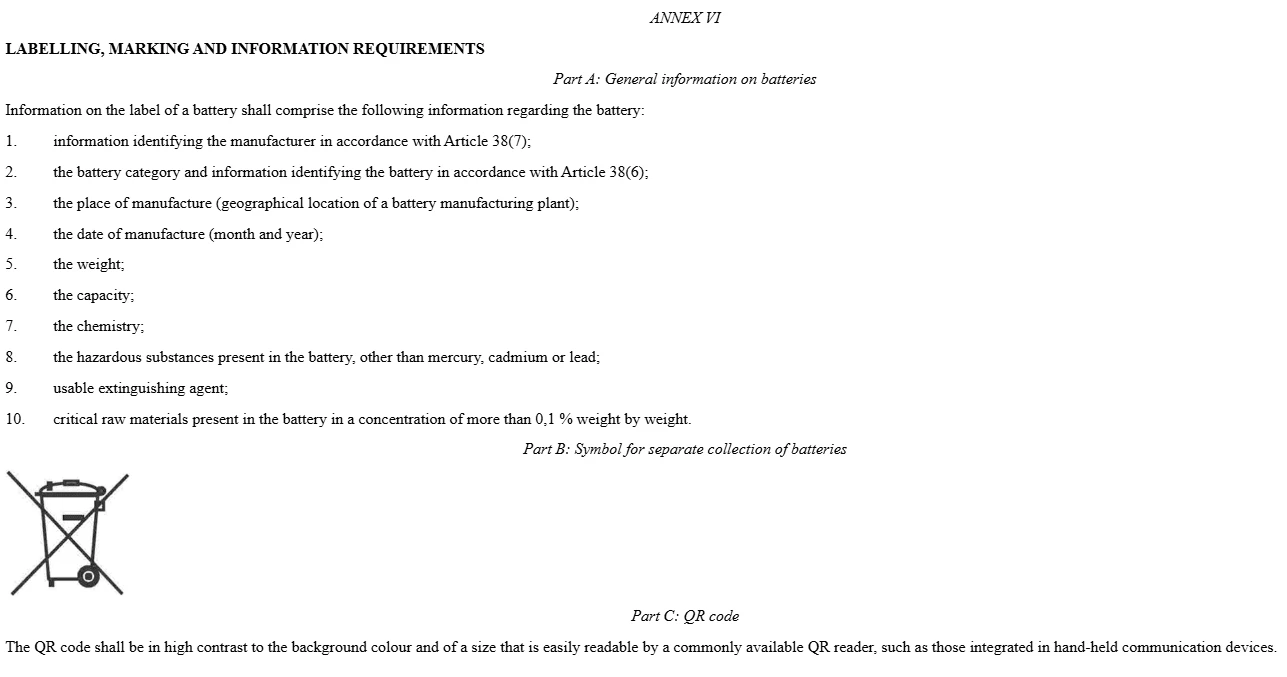
The general battery information is listed in Annex VI, Part A.
Here are the 10 main information items.
The information should identify the battery manufacturer.
It includes:
-
Manufacturer's name
-
Registered trade name or trademark
-
Postal address and contact point
-
Website and email address, if available
This helps buyers, importers and other users identify the company responsible for the battery.
The information should include:
-
Battery category
-
Battery model
-
Batch number or serial number
-
Product number or another identification number, where applicable
These details are important for product identification and traceability.
A buyer should be able to identify which battery model the information belongs to.
The geographical location of the battery manufacturing plant should be provided.
This helps users identify where the battery was produced.
The manufacturing date should be provided in month and year format.
For example:October 2026
Provide the weight of the battery.
The information should clearly identify the relevant battery model.
Provide the battery capacity.
For rechargeable batteries, this information helps users understand the energy storage capability of the battery.
Identify the battery chemistry.
For example:
-
Lithium-ion (Li-ion)
-
Lithium Iron Phosphate (LiFePO4)
-
Nickel-Metal Hydride (NiMH)
-
Lead-acid
The actual chemistry should match the battery being supplied.
Provide information about hazardous substances present in the battery, other than mercury, cadmium and lead.
This helps users understand the substances contained in the battery and their potential environmental impact.
Provide information about the usable extinguishing agent for the battery.
This is important for battery fire safety.
The information should be based on the battery's actual chemistry and safety documentation.
Provide information about critical raw materials present in the battery at a concentration of more than 0.1% by weight.
This requirement helps improve transparency about the materials used in batteries.
These 10 items are listed in Annex VI, Part A of the EU Battery Regulation.
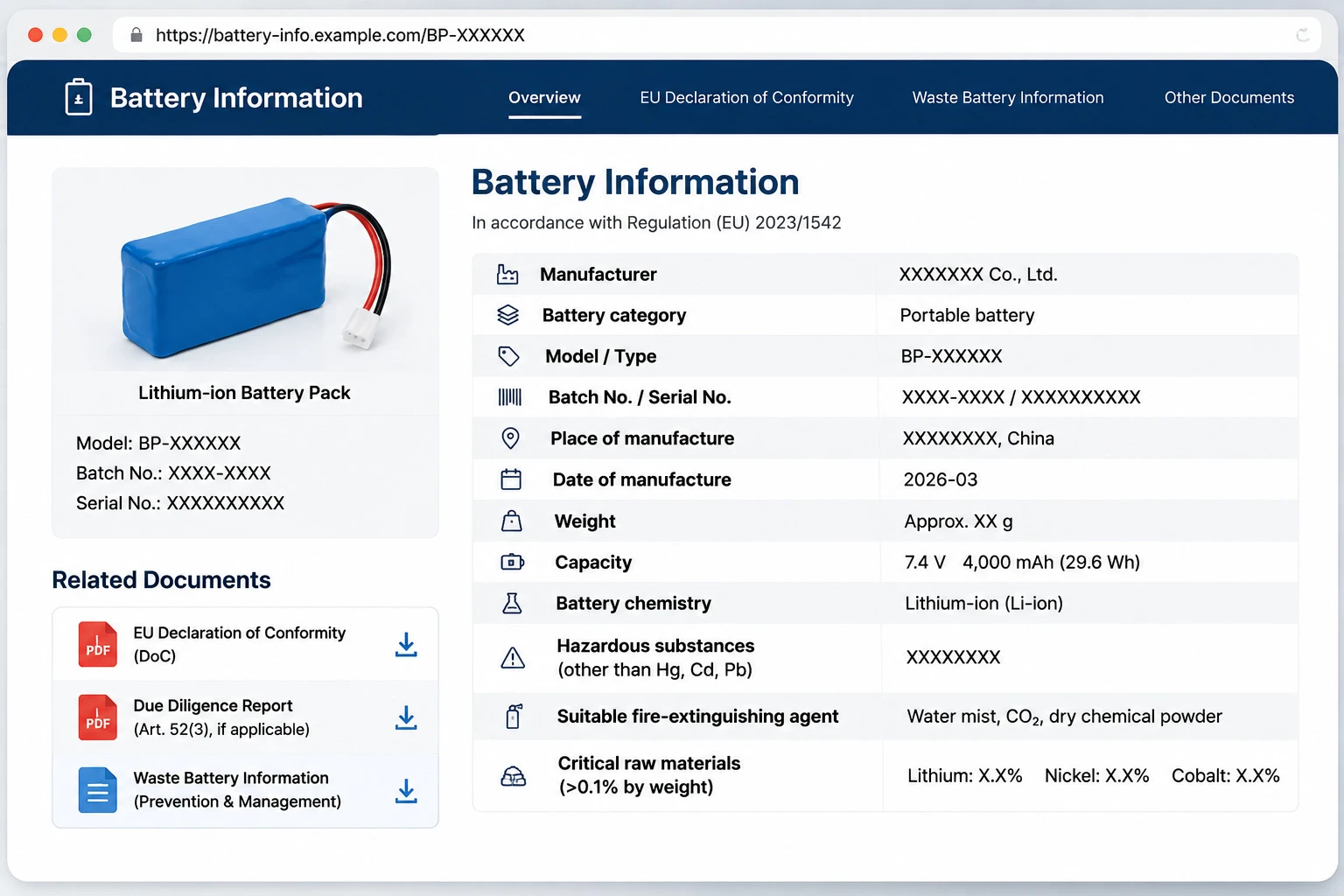
Other Documents and Information Required Behind the QR Code
The 10 items above are not the only information required.
For batteries that do not require a Battery Passport, Article 13(6)(b) also refers to the following information and documents.
The QR code should provide access to the applicable EU Declaration of Conformity.
The DoC identifies the battery model and declares its conformity with the relevant EU requirements.
Importers and buyers can use this document to check the battery's compliance information.
Article 13(6)(b) also refers to the report under Article 52(3).
This is a report on the battery due diligence policy of an economic operator that falls within the scope of the relevant due diligence requirements.
It provides information about the company's actions to identify and address risks in its battery raw material supply chain.
Please note that this report is not a general document required from every battery supplier. Its applicability depends on the economic operator and the relevant legal requirements.
Article 74(1) requires information about the prevention and management of waste batteries.
The information should cover:
- Extending battery life: Good practices to help users extend battery life and reduce battery waste.
- Separate collection: How users can correctly separate and collect waste batteries.
- Collection points: Information about battery take-back schemes and available collection points.
- Safety instructions: How to handle waste batteries safely, including risks related to lithium batteries.
- Battery labels and symbols: What the different battery labels and symbols mean.
- Environmental impact: How battery substances can affect human health and the environment, especially when batteries are disposed of incorrectly.
Who Should Create the Website and QR Code?
This is one of the most common questions from battery suppliers and importers.
The regulation requires the QR code to provide access to the relevant information. It does not state that only the battery supplier must create the website.
In practice, the process can be arranged between the battery manufacturer, supplier and importer.
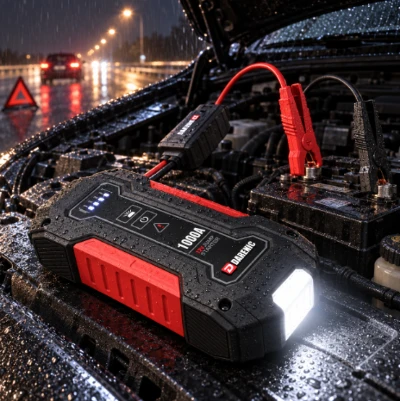
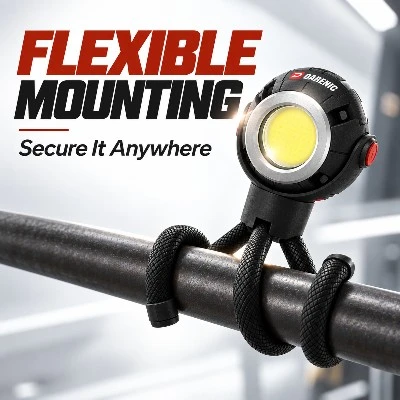
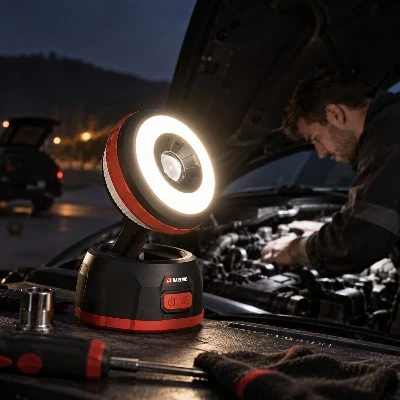
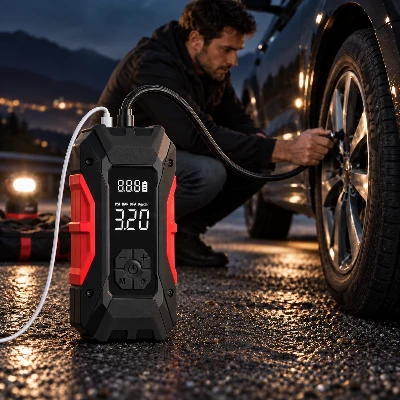
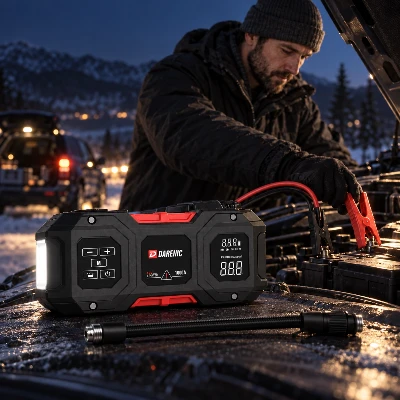
Importing battery-powered work lights, tire inflators or jump starters into the EU?
NEED HELP WITH YOUR BATTERY QR CODE?
We can work with you and the battery supplier to organize the required battery information, coordinate QR code preparation and discuss label and packaging requirements.
Here is a practical way to prepare it.
The battery supplier or the responsible business operator can prepare a dedicated webpage.
This page should contain the required battery information and documents.
For example:
www.example.com/battery-information/model-001
The webpage should be:
- Easy to access.
- Available without unnecessary login requirements.
- Clear and easy to read.
- Linked to the correct battery model.
- Updated when the battery information changes.
The battery supplier should prepare the technical information.
The importer and other responsible parties should check that the information is complete and accurate.
Noted:Do not simply copy information from another battery model. The data must match the actual battery.
After the information page is ready, a QR code can be generated using its URL.
Both the battery supplier and importer can arrange the technical work, depending on their agreement.
However, there is an important legal point.
For batteries requiring a Battery Passport, Article 77 states that the economic operator placing the battery on the EU market must assign the unique identifier and ensure that the passport information is accurate, complete and up to date.
This operator may give written authorisation to another operator to act on its behalf.
Therefore, the supplier and importer should agree in advance on:
- Who prepares the information page.
- Who generates the QR code.
- Who owns and maintains the webpage.
- Who updates the information.
- Who is responsible for regulatory compliance.
Generating a QR code is easy. Making sure the information behind it is correct and remains available is much more important.
Where Should the QR Code Be Printed?
According to Article 13(7), the QR code should be printed or engraved visibly, legibly and permanently on the battery.
In practice, there are several things to consider.
If there is enough space, the QR code should be printed or engraved directly on the battery.
The code should be:
- Clearly visible.
- Easy to scan.
- Durable.
- Resistant to normal handling and use.
Some batteries have limited space for labels.
If printing or engraving the QR code on the battery is not possible or is not appropriate because of its size or nature, the regulation allows the QR code to be placed on:
- The battery packaging.
- The documents accompanying the battery.
For example, a printed QR code can be attached to the battery packaging, with the same code included in the accompanying product documentation.
For shipment preparation, an A4 printed sheet attached to the relevant packaging can be a practical option, provided the legal placement requirements are met.
Make sure the QR code stays with the correct battery and can still be scanned after packaging and transport.
If the battery is supplied as a battery pack, its own nameplate or identification label is an important place to consider for the QR code.
When the battery pack itself is the regulated battery, the QR code should be included on its battery label whenever possible.
Do not rely only on a label on the outside of the finished product if the QR code is required on the battery itself and no size or nature exception applies.

Before printing labels or packaging in large quantities, we recommend checking:
- Is the QR code large enough?
- Can a normal smartphone scan it?
- Is there enough contrast between the code and background?
- Does the link open the correct information page?
- Does the page work on mobile phones?
- Does the QR code remain readable after printing?
Annex VI, Part C also requires the QR code to have high contrast and a size that can be easily read by commonly available QR readers.
A Practical Checklist for Battery Suppliers and Importers
If you are preparing for the EU Battery Regulation 2023/1542, the following checklist can help.
|
Task |
What to check |
|
1. Identify battery category |
Confirm whether it is portable, LMT, EV, industrial or SLI |
|
2. Collect battery data |
Prepare the applicable 10 information items |
|
3. Prepare documents |
EU DoC and other applicable documents |
|
4. Prepare waste information |
Check Article 74 requirements |
|
5. Set up the online page |
Make sure the information is accessible |
|
6. Generate the QR code |
Link it to the correct battery information |
|
7. Confirm responsibilities |
Agree who manages and updates the information |
|
8. Check the label |
Confirm QR code size, position and readability |
|
9. Test the QR code |
Scan it before mass production |
A good suggestion: Start collecting the battery information early. Do not wait until the final packaging design is ready.
This can help avoid unnecessary changes to labels, packaging and production arrangements.
Important Dates: Do Not Confuse Battery Labels with QR Codes
The EU Battery Regulation introduces several marking requirements at different stages.
Here are two important dates to understand:
|
Requirement |
Application date |
|
Separate collection symbol |
18 August 2025 |
|
QR code on all batteries |
18 February 2027 |
There is also a separate timeline for the general battery information label listed in Annex VI, Part A.
Under Article 13(1)–(3), its application date is 18 August 2026 or 18 months after the relevant implementing act enters into force, whichever is later.
Therefore, do not assume that the QR code deadline and the general label deadline are the same.
Always check the latest official EU requirements before finalising your battery labels and packaging.

FAQ:Frequently Asked Questions
Q1: Does every battery need a Digital Battery Passport?
No. All batteries need a QR code from 18 February 2027.
However, a full Battery Passport is required for EV batteries, LMT batteries and industrial batteries with a capacity greater than 2 kWh.
Other battery categories need their QR code to provide access to the applicable information and documents.
Q2: Can the importer generate the QR code instead of the battery supplier?
The importer can arrange the technical work with the supplier or a service provider.
For batteries requiring a Battery Passport, the economic operator placing the battery on the EU market remains responsible for the passport information, but can authorise another operator in writing to act on its behalf.
The responsibilities should be clearly agreed before production.
Q3: Can we put the QR code on the product packaging instead of the battery?
Yes, but only when printing or engraving it on the battery is not possible or is not appropriate because of the battery's nature or size.
In this case, Article 13(7) requires it to be affixed to the packaging and the documents accompanying the battery.
Q4: Is a normal QR code generator enough?
A QR code generator can create the visual code, but it does not prepare the required battery information.
You still need a correct online information page or digital record.
For Battery Passport applications, additional requirements apply to the unique identifier, data structure and interoperability.
Q5: Is the QR code the same as CE marking?
No.CE marking and the battery QR code have different purposes.
CE marking indicates conformity with applicable EU legislation. The QR code provides access to battery information and required documents.
OUR REAL-WORLD CASE
How do the importer, product manufacturer and battery supplier work together? See how the process works in a practical customer case.
Final Thoughts
The EU Battery Regulation 2023/1542 is not just about adding a QR code to a battery label.
It is also about making battery information easier to identify, access and trace throughout the battery's life.
For battery manufacturers and suppliers, the first step is to collect accurate product information and work with importers to decide who will prepare and maintain the online information page.
For importers, it is important to check the battery category, required documents, QR code location and the responsibilities of each party.
Preparing these details early can make the transition much easier.
Looking for battery-powered automotive work lights, tire inflators or jump starters?
When choosing a supplier, remember to check not only the product specifications but also the battery information and documentation available for your target market.
Feel free to contact our team to discuss your product requirements.
For more details, please refer to the official EU sources:
- Regulation (EU) 2023/1542 – Batteries and Waste Batteries (EUR-Lex)
See Article 13, Article 18, Article 38, Article 52, Article 74, Article 77 and Annexes VI and XIII. - European Commission – Guidance to Support Preparations for the Digital Batteries Passport
Published on 21 August 2026.
Disclaimer: This article is for general information only. It is not legal advice. Battery classification and compliance obligations depend on the battery type, product design and the role of each economic operator. Please check the latest EU legislation and consult a qualified compliance professional when necessary.
Send Inquiry